

Murtabak

Origin and Regional Cuisine
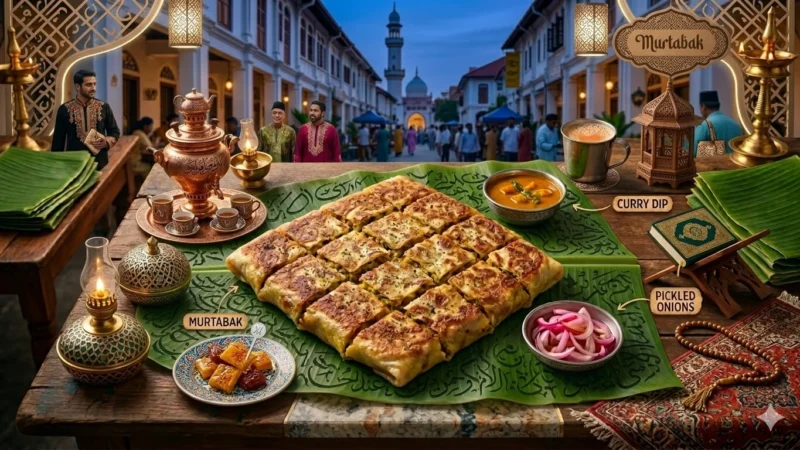
Murtabak is a popular stuffed pancake or pan-fried bread widely enjoyed across Malaysia, Singapore, Indonesia, Brunei, and parts of the Middle East. The dish traces its roots to Arab traders and Indian Muslim communities, particularly from Yemen and South India, who introduced the concept of stuffed flatbreads to Southeast Asia centuries ago.
Over time, local communities adapted the recipe to regional tastes, incorporating local spices, minced meat, eggs, and onions. In Malaysia, Murtabak has become a staple street food often served at night markets, Ramadan bazaars, and mamak restaurants.

Today, variations such as Murtabak ayam (chicken), Murtabak daging (beef), and Murtabak kambing (mutton) are widely enjoyed.
Category
Murtabak falls under several culinary categories:
- Street food
- Savory stuffed flatbread
- Pancake-style dish
- Main meal or snack
It is commonly eaten during dinner or supper and is often paired with curry gravy or pickled onions.
Appearance
Murtabak typically appears as a large rectangular or square flatbread that is golden-brown and crispy on the outside. After cooking, it is usually cut into smaller square pieces.
The outer layer is thin and flaky, while the inside contains a flavorful mixture of meat, egg, and spices.
Ingredients
Traditional Murtabak ingredients include:
- Wheat flour dough (similar to roti canai dough)
- Minced meat (beef, chicken, or mutton)
- Eggs
- Onions
- Garlic
- Curry powder or spices
- Salt and pepper
- Cooking oil or ghee
Some modern variations include cheese, sardines, vegetables, or sweet fillings.
Preparation
Preparing Murtabak involves several steps:
- Preparing the dough and letting it rest.
- Cooking the minced meat with spices and onions.
- Stretching the dough thinly on a flat surface.
- Adding egg and cooked meat mixture.
- Folding the dough into a square parcel.
- Frying it on a hot griddle until golden brown.
Equipment
The common equipment used to prepare Murtabak includes:
- Flat griddle or frying pan (tawa)
- Mixing bowls
- Spatula
- Dough rolling surface
- Knife for cutting
Street vendors often prepare it on a large steel griddle where multiple portions are cooked simultaneously.
Taste
Murtabak has a rich, savory, and slightly spicy taste.
The combination of seasoned meat, eggs, and curry spices creates a bold flavor profile. When served with curry sauce or pickled onions, the dish becomes even more flavorful.
Texture
The texture of Murtabak is a unique combination of:
- Crispy and flaky exterior
- Soft and juicy filling
The thin dough layers become crunchy during frying while the interior remains moist and tender.
Aroma
When cooking, Murtabak releases a strong and appetizing aroma due to:
- fried onions
- curry spices
- sizzling meat
- toasted flatbread
This aroma is often what attracts customers at night markets and food stalls.
Cultural Significance
Murtabak plays an important role in Malaysian and Singaporean street food culture.
It is commonly sold at:
- Ramadan bazaars
- night markets (pasar malam)
- mamak restaurants
- street food stalls
Families and friends often share Murtabak together, especially during late-night meals.
Symbolism
Although not a ceremonial dish, Murtabak symbolizes:
- multicultural culinary heritage
- Middle Eastern and South Asian influence
- the vibrant street food traditions of Southeast Asia
It reflects how migration and trade shaped regional cuisines.
Social Context
Murtabak is typically enjoyed in social settings such as:
- family dinners
- late-night gatherings
- Ramadan evenings after breaking fast
- street food markets
Because it is usually cut into pieces, it is commonly shared among groups.
Nutritional Information and Health Benefits
Murtabak provides a good amount of energy due to its ingredients.
Approximate nutritional aspects include:
- Protein from meat and eggs
- Carbohydrates from the dough
- Fats from frying oil
- Vitamins from onions and spices
However, since it is pan-fried, it should be consumed in moderation.
Dietary Restrictions and Allergens
People with certain dietary restrictions should note:
- Contains gluten (wheat flour)
- Contains eggs
- May contain dairy if ghee or butter is used
- Not suitable for vegetarians unless a vegetable version is prepared
Halal versions are commonly available in Malaysia and Singapore.
Cost and Availability
Murtabak is widely available across Southeast Asia.
Typical price range:
| Location | Average Price |
|---|---|
| Malaysia | RM6 – RM15 |
| Singapore | SGD 6 – SGD 12 |
| Indonesia | IDR 20,000 – 50,000 |
Prices vary depending on the filling such as chicken, beef, or mutton.
The Key Components of Nasi Kerabu
Although Nasi Kerabu is a different Malaysian dish, its components highlight the diversity of Malay cuisine. The key components include:
- Blue-colored rice (from butterfly pea flowers)
- Fresh herbs and vegetables
- Fried fish or grilled meat
- Sambal (spicy chili paste)
- Salted egg or crackers
These components showcase the rich flavors and traditional culinary practices of Malaysia.
Cultural Significance and Popularity
Murtabak has grown beyond a simple street food and is now an iconic dish in Southeast Asian food culture.
During Ramadan, demand increases significantly as many families buy Murtabak from bazaar stalls for iftar meals. Its popularity has also expanded internationally, appearing in restaurants across the Middle East, Australia, and Europe.
How to Prepare Murtabak
INGREDIENTS
For the dough:
- 2 cups wheat flour
- 1 teaspoon salt
- 1 tablespoon oil
- Water as needed
For the filling:
- 200 g minced meat (beef or chicken)
- 2 eggs
- 1 chopped onion
- 2 cloves garlic (minced)
- 1 teaspoon curry powder
- Salt and pepper
- Cooking oil
DIRECTION
- Mix flour, salt, oil, and water to form a soft dough. Let it rest for 30 minutes.
- Cook minced meat with onions, garlic, and curry powder until fully cooked.
- Beat eggs and mix with the cooked meat filling.
- Stretch the dough thinly on an oiled surface.
- Place the filling in the center of the dough.
- Fold the edges to form a square parcel.
- Fry on a hot griddle with oil until both sides turn golden brown.
- Cut into smaller squares and serve hot with curry sauce.
NOTES
- Resting the dough improves elasticity and makes it easier to stretch.
- Use medium heat to avoid burning the outer layer.
- Murtabak is best served immediately while crispy.
FAQ
What is Murtabak made of?
Murtabak is made with thin dough filled with minced meat, eggs, onions, and spices, then pan-fried until crispy.
Is Murtabak Malaysian or Middle Eastern?
Murtabak originated from Arab cuisine but became widely popular in Southeast Asia, especially Malaysia, Singapore, and Indonesia.
Is Murtabak spicy?
The spice level is usually mild to moderate, depending on the amount of curry powder and chili used.
What is served with Murtabak?
It is commonly served with curry gravy, pickled onions, or chili sauce.

- Temperature
- Precipitation
- Rain Chance
- Wind
- Humidity
- Pressure


Can Murtabak be vegetarian?
Yes, vegetarian versions can include vegetables, tofu, or plant-based fillings instead of meat.









Comments are closed.