

How the Official Eid Date Is Decided in Malaysia

Introduction
Eid al-Fitr is one of the most significant Islamic celebrations in Malaysia, marking the end of the holy month of Ramadan. However, unlike many public holidays that have fixed dates, the official date of Eid changes every year. This is because it is determined according to the Islamic lunar calendar and depends on the sighting of the new crescent moon.
In Malaysia, the process of confirming the Eid date follows a structured religious and governmental procedure that combines traditional Islamic practices with modern astronomical science. From official moon-sighting stations to national announcements, the system ensures accuracy and religious authenticity.
This complete guide explains how the official Eid date is decided in Malaysia, including the role of Islamic authorities, moon sighting methods, and the final national announcement.
Understanding the Islamic Lunar Calendar
The Islamic calendar, also known as the Hijri calendar, is based entirely on the phases of the moon.
Key Features of the Islamic Calendar
| Feature | Description |
|---|---|
| Calendar Type | Lunar Calendar |
| Number of Months | 12 Months |
| Month Length | 29 or 30 days |
| Month Start | Begins after crescent moon sighting |
In the Islamic calendar:
- Ramadan is the 9th month
- Shawwal is the 10th month
- Eid al-Fitr is celebrated on the 1st day of Shawwal
Since the lunar year is about 354 days, which is roughly 10–11 days shorter than the Gregorian calendar, Ramadan and Eid move earlier each year.
Authorities Responsible for Announcing Eid in Malaysia
The responsibility for determining the official Eid date in Malaysia lies with several national Islamic institutions.
Key Authorities Involved
- Department of Islamic Development Malaysia (JAKIM)
- Conference of Rulers
- Keeper of the Rulers’ Seal (Penyimpan Mohor Besar Raja-Raja)
The Keeper of the Rulers’ Seal plays a central role in the process. After receiving verified reports from moon-sighting locations, this official makes the nationwide Eid announcement through television and radio broadcasts.
This announcement officially confirms the start of 1 Shawwal, marking the beginning of Eid celebrations.
The Moon Sighting Method Used in Malaysia
Malaysia follows a combined system known as Rukyah and Hisab to determine the start of the new Islamic month.
Explanation of the Method
| Method | Meaning |
|---|---|
| Rukyah | Physical observation of the crescent moon |
| Hisab | Astronomical calculations predicting moon visibility |
This hybrid approach ensures that the decision follows Islamic tradition while incorporating scientific calculations.
Astronomical data helps determine whether the moon should be visible, while the actual observation confirms its presence.
Official Moon Sighting Locations in Malaysia
To observe the crescent moon, Malaysia has 29 official observation sites across the country. These locations are carefully chosen for their clear horizon views and suitable elevation.
Notable Moon Observation Sites
- Bukit Melawati (Selangor)
- Teluk Kemang (Negeri Sembilan)
- Balai Cerap Al-Khawarizmi (Melaka)
- Langkawi National Observatory (Kedah)
- Kuala Lumpur Tower
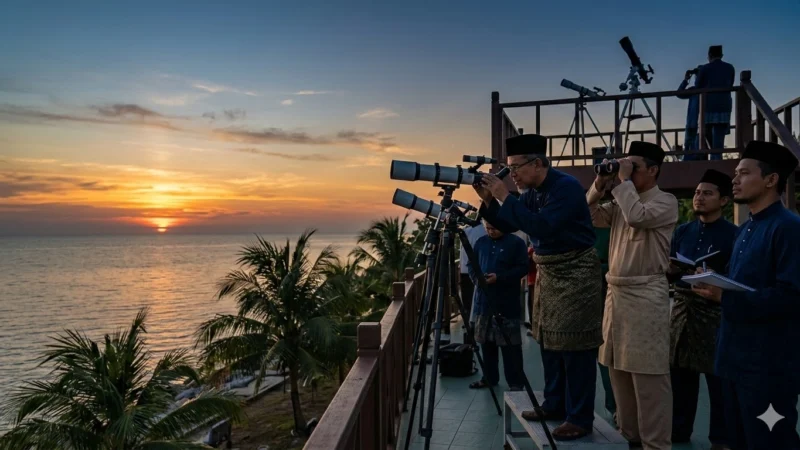
At these sites, astronomers, religious scholars, and trained officials gather on the 29th evening of Ramadan to observe the moon using telescopes and other astronomical equipment.
The Imkanur Rukyah Criteria
Malaysia uses a specific standard known as Imkanur Rukyah, which defines the minimum conditions required for the moon to be visible.
Minimum Visibility Requirements
| Requirement | Minimum Value |
|---|---|
| Moon altitude at sunset | At least 3 degrees above the horizon |
| Moon-sun elongation | At least 6.4 degrees |
If these conditions are met, the crescent moon is considered potentially visible, making it possible for the new Islamic month to begin.
What Happens on the 29th Night of Ramadan
The moon sighting process follows a clear and structured procedure.
Step-by-Step Process
- Observers gather at official observation points before sunset.
- Astronomical equipment and telescopes are prepared.
- After sunset, observers attempt to locate the crescent moon.
- Observations are documented and reported to Islamic authorities.
- The reports are reviewed and verified.
- The final decision is presented to the Conference of Rulers.
If the crescent moon is confirmed, the following day becomes 1 Shawwal, which is Eid al-Fitr.
What Happens If the Moon Is Not Seen
If the crescent moon cannot be sighted on the 29th evening of Ramadan, the fasting month continues for 30 days.
In this situation:
- Ramadan completes the full 30-day cycle
- Eid al-Fitr is celebrated the next day
This practice follows the traditional Islamic principle of completing the month if the moon cannot be confirmed.
The Official Eid Announcement in Malaysia
Once the decision is finalized, the Keeper of the Rulers’ Seal delivers the official announcement.
The announcement is broadcast through:
- National television
- Radio stations
- Government media channels
The statement traditionally begins with a formal declaration confirming the start of 1 Shawwal.
Millions of Malaysians eagerly wait for this announcement, as it signals the official end of Ramadan fasting.
Why Eid Dates May Differ Between Countries
Eid may be celebrated on different days across the world because moon visibility varies depending on geographic location.
Several factors influence the date:
- Different moon sighting criteria
- Variations in astronomical calculations
- Some countries rely only on physical moon sighting
- Others rely more on astronomical predictions
Malaysia uses a balanced hybrid method, combining scientific calculations with traditional observation.
Cultural Importance of the Eid Announcement
In Malaysia, the official Eid announcement is more than a religious confirmation—it is also a national cultural moment.
Once the date is confirmed:
- Mosques prepare for Takbir Raya
- Families begin final festive preparations
- Travel for balik kampung (returning to hometowns) increases
- Traditional dishes such as ketupat, rendang, and lemang are prepared
The announcement officially marks the transition from Ramadan to the joyful celebration of Hari Raya Aidilfitri.
Frequently Asked Questions (FAQ)
Who officially declares Eid in Malaysia?
The Keeper of the Rulers’ Seal (Penyimpan Mohor Besar Raja-Raja) officially announces the Eid date after receiving verified moon-sighting reports.
How many moon sighting locations are there in Malaysia?
Malaysia has 29 official observation locations where the crescent moon is observed on the evening of the 29th day of Ramadan.
What happens if the moon is not visible?
If the crescent moon cannot be seen, Ramadan completes 30 days, and Eid is celebrated the following day.
Does Malaysia rely on calculations or moon sighting?
Malaysia uses both astronomical calculations (Hisab) and physical moon sighting (Rukyah).
Why does the Eid date change every year?
The Islamic lunar calendar is about 10–11 days shorter than the Gregorian calendar, which causes Ramadan and Eid to shift earlier each year.






Comments are closed.