

Top 10 Best-Selling Laptop Brands in the World (2026)

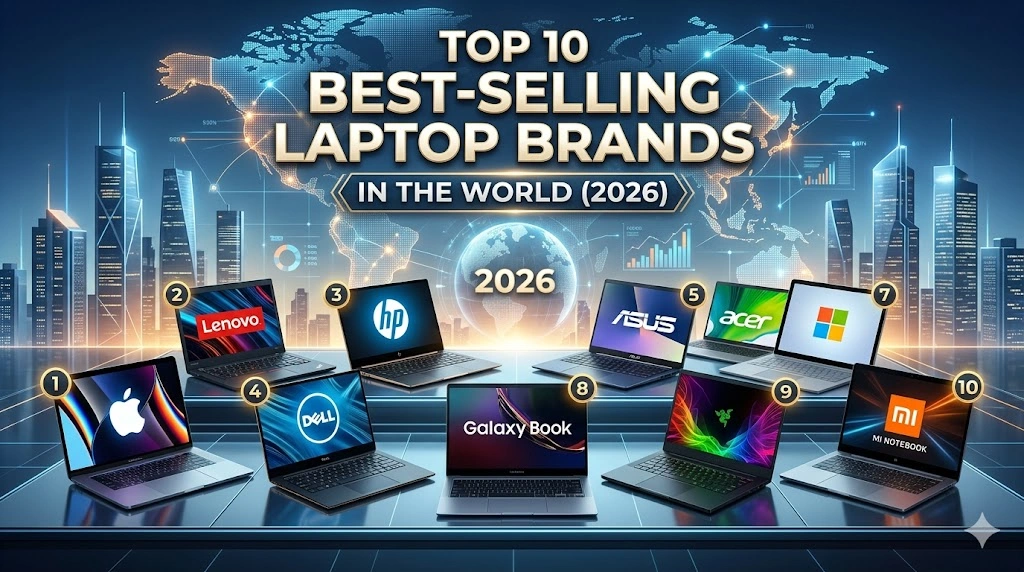
The global laptop industry continues to evolve rapidly as consumers, students, businesses, gamers, and content creators demand faster, smarter, and more portable devices. From AI-powered computing to ultra-thin productivity machines and gaming-focused hardware, the competition among manufacturers has never been stronger.
According to recent market estimates, these are the world’s top-selling laptop brands based on annual unit sales.
Top 10 Laptop Brands by Annual Sales
| Rank | Brand | Country | Annual Units Sold |
|---|---|---|---|
| 1 | Lenovo | China | 48.5 Million |
| 2 | HP | United States | 39.0 Million |
| 3 | Dell | United States | 28.5 Million |
| 4 | Apple | United States | 23.5 Million |
| 5 | ASUS | Taiwan | 15.5 Million |
| 6 | Acer | Taiwan | 14.0 Million |
| 7 | MSI | Taiwan | 3.0 Million |
| 8 | Samsung | South Korea | 2.5 Million |
| 9 | Microsoft | United States | 2.5 Million |
| 10 | Huawei | China | 2.0 Million |
Why Lenovo Leads the Global Market
Lenovo continues to dominate the worldwide laptop market with nearly 48.5 million units sold annually. The company’s success is driven by its strong business ecosystem, affordable pricing strategy, reliable ThinkPad lineup, and aggressive expansion in emerging markets.
Lenovo also benefits from:
- Wide product portfolio
- Strong enterprise partnerships
- Competitive gaming laptops
- Budget-friendly student devices
- Global supply chain efficiency
Its ability to balance affordability, reliability, and performance has made it a preferred choice for both enterprise users and everyday consumers.
HP and Dell Continue Corporate Dominance
HP and Dell remain dominant in the commercial, enterprise, and education sectors. Their devices are widely used in offices, universities, and government institutions worldwide.
HP Strengths
- Reliable business laptops
- Strong global retail presence
- Affordable consumer models
- Extensive after-sales support
Dell Strengths
- Premium enterprise devices
- High-performance workstations
- Excellent corporate support services
- Popular XPS and Alienware product lines
Both brands continue benefiting from remote work adoption, hybrid learning, and increasing enterprise digital transformation.
Apple’s Premium Strategy Continues to Succeed
Apple ranks fourth globally with approximately 23.5 million laptop sales annually. Although MacBooks remain more expensive than many competitors, the brand maintains strong demand among:
- Content creators
- Video editors
- Developers
- Students
- Business professionals
The transition to Apple Silicon processors significantly improved performance efficiency and battery life, strengthening Apple’s premium laptop ecosystem.
ASUS and Acer Win the Budget & Gaming Battle
Taiwanese brands ASUS and Acer remain highly competitive in both gaming and budget-friendly laptop categories.
ASUS
ASUS has built a strong reputation through:
- ROG gaming laptops
- Creator-focused devices
- Slim ultrabooks
- Affordable VivoBook models
Acer
Acer continues attracting students and casual users with:
- Competitive pricing
- Lightweight laptops
- Strong Chromebook lineup
- Predator gaming series
Both brands continue expanding aggressively in emerging consumer markets.
MSI’s Gaming Strategy Pays Off
Although MSI sells fewer units compared to larger manufacturers, it remains one of the most respected names in gaming laptops.
The company focuses heavily on:
- High-refresh-rate displays
- Advanced cooling technology
- Powerful GPUs
- Performance-oriented designs
MSI’s niche gaming strategy has helped it maintain a loyal international audience.
Samsung, Microsoft, and Huawei Stay Competitive
Samsung, Microsoft, and Huawei continue targeting premium productivity users with lightweight, AI-focused laptops and integrated ecosystems.
These brands are increasingly investing in:
- AI integration
- Cloud computing ecosystems
- Cross-device connectivity
- Thin-and-light premium devices
Despite geopolitical challenges, Huawei continues maintaining strong market presence in selected Asian and European regions.
Future of the Laptop Industry
The global laptop market is expected to become even more competitive as AI-powered computing, ARM-based processors, and cloud-connected ecosystems reshape consumer expectations.
Key future trends include:
- AI-assisted productivity tools
- Longer battery life
- Ultra-light premium designs
- Sustainable manufacturing
- Advanced gaming performance
- Foldable and dual-screen laptops
As demand continues rising across education, gaming, remote work, and digital content creation, manufacturers are expected to invest heavily in innovation and ecosystem integration.

 29°C
29°C
- Temperature
- Precipitation
- Rain Chance
- Wind
- Humidity
- Pressure


Conclusion
Lenovo currently leads the global laptop market by a significant margin, while HP, Dell, Apple, ASUS, and Acer continue dominating key enterprise and consumer segments.
Meanwhile, specialized brands such as MSI are successfully carving out loyal audiences in gaming and performance computing.
As AI and next-generation computing technologies move further into the mainstream, competition among laptop manufacturers is expected to intensify significantly over the next few years.












Comments are closed.