

Istana Budaya

Synopsis
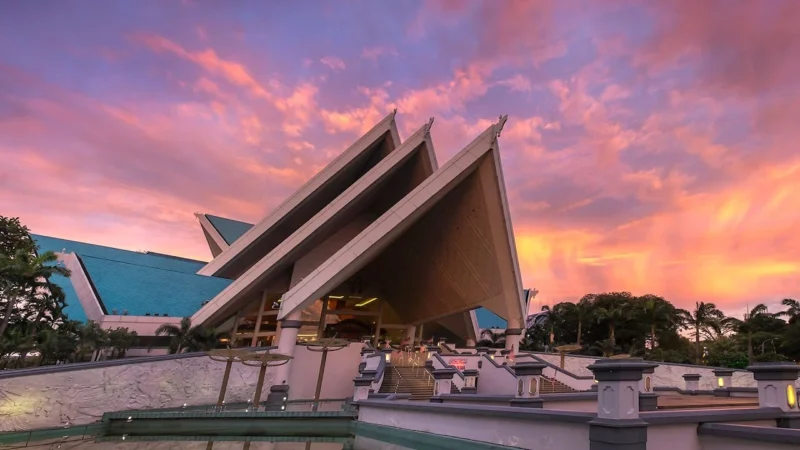
Istana Budaya Known as Malaysia’s Cultural Palace, Istana Budaya in Kuala Lumpur stands as the heart of the nation’s performing arts scene. Opened in 1999, this magnificent building serves as the National Theatre of Malaysia, showcasing a diverse range of cultural, theatrical, and musical performances that celebrate both local heritage and international artistry.
Overview
Located along Jalan Tun Razak in Kuala Lumpur, Istana Budaya is a landmark institution dedicated to the performing arts. Officially opened in 1999, the theatre represents Malaysia’s vision to promote local talent while hosting world-class productions. The name Istana Budaya translates to “Palace of Culture,” and it truly lives up to its name — combining cutting-edge stage technology with architectural grandeur inspired by traditional Malay design.
Timeline
| Year / Period | Milestone | Key Insight |
|---|---|---|
| 1964 | Initial proposal by Ministry of Information & Broadcasting and Ministry of Culture & Social Welfare | Vision to create a National Cultural Centre highlighting Malaysia’s heritage and creative identity. |
| 1971 | National Cultural Congress discussions | Recognition of the need for a national performing arts institution to preserve and promote cultural expression. |
| 1972 | Formation of the National Cultural Group (KBN) | Foundation for structured cultural development under the government’s arts division. |
| 1974 | KBN becomes professionally active under KKBS | Transition from amateur to professional status, focusing on traditional dance and music as core identity pillars. |
| 1982 | Establishment of the Youth Symphony Orchestra (OSM) | Expansion of Malaysia’s musical landscape and nurturing young artistic talent. |
| 1992 | Creation of the National Choir Group | Strengthening Malaysia’s performing arts ecosystem through diversified artistic representation. |
| 1993 | Construction of the Experimental Theatre (ET) begins; OSM upgraded to National Symphony Orchestra (OSK) | Institutional maturity and experiential preparation for a national-scale theatre operation. |
| 1994 | ET inaugurated by Tun Dr. Mahathir Mohamad | Symbolic milestone demonstrating Malaysia’s readiness for a permanent cultural institution. |
| 1995 | Construction of National Theatre (Istana Budaya) begins | Strategic investment of RM210 million marks a new era for national arts infrastructure. |
| 1998 | Completion of construction and administrative relocation to Jalan Tun Razak | Physical realization of Malaysia’s long-term cultural vision. |
| 1999 (15 September) | Official opening of Palace of Culture (Istana Budaya) | Culmination of decades of effort, representing Malaysia’s premier performing arts venue blending tradition and innovation. |
Quick Facts
| Attribute | Details |
|---|---|
| Location | Jalan Tun Razak, Kuala Lumpur, Malaysia |
| Established | 1999 |
| Function | National Theatre / Cultural Palace |
| Architectural Style | Malay Traditional House (Rumah Melayu) Concept |
| Managed by | Ministry of Tourism, Arts and Culture Malaysia |
| Category | Heritage & Cultural Landmark |
History
The idea of creating a national theatre was first proposed in the late 1970s to provide a dedicated venue for Malaysia’s growing performing arts community. After years of planning, Istana Budaya officially opened its doors in September 1999.
Its design was conceptualized by Ar. Muhammad Kamar Ya’akub, who drew inspiration from the Rumah Terengganu, a traditional Malay house. Every section of the building reflects Malaysian culture — from the serambi (veranda) to the rumah ibu (main house), blending modern functionality with cultural symbolism.
Architectural Highlights
Istana Budaya is often hailed as one of the most sophisticated theatres in Asia.
- The roof structure resembles a traditional sirih junjung (betel leaf arrangement), symbolizing Malaysian hospitality.
- Its interior features intricate carvings, motifs, and textiles inspired by Malay art.
- The main auditorium, known as Panggung Sari, accommodates up to 1,400 people, with advanced stage machinery, orchestra pits, and rotating platforms suitable for large-scale productions.
- The building’s design concept allows visitors to experience a “journey through Malay culture,” from entrance to stage.
Cultural Significance
Istana Budaya serves as Malaysia’s premier performing arts venue, hosting national and international performances — from traditional Malay theatre (bangsawan and mak yong) to musicals, operas, ballets, and concerts. It also provides a platform for local artists, nurturing the next generation of Malaysian performers and cultural ambassadors.
Malaysian Traditional Orchestra
The Malaysian Traditional Orchestra (OTM) was launched on 6 February 2010 and was officiated by Yang Berhormat Dato’ Seri Utama Dr. Rais Yatim, Minister of Information, Communications and Culture. Currently, OTM is under the auspices of the Ministry of Tourism, Arts and Culture and managed by Istana Budaya. The establishment of OTM is in line with the vision of the Ministry of Tourism, Arts and Culture (MOTAC) to promote appreciation of arts to all Malaysians.
OTM is the only unique orchestra that carries the image of Malaysia with a combination of traditional musical instruments representing various ethnicities and races such as Malays, Indians, Chinese, Sabah and Sarawak.
OTM Traditional Musical Instruments
Category Instruments Bowed String Fiddle, Erhu, Gaohu, Zhong Hu, Cello, Double Bass Plucked Strings Yang Qin, Sape, Sitar, Gambus, Mandolin, Zhong Ruan, Pipe Woodwinds Flute, Bansi, Seluang, Pupuik, Dizzy, Sauna Gamelan Bonang, Sharon Pekin, Sharon Baron, Gamelan Gong, Xylophone, Demung, Greteh Percussion Malay Drums, Kompang, Marwas, Latin Percussion, Tabla Rhythm Section Keyboards, Drums, Electric Bass, Acoustic Guitar
Jewel of Music Art
The PERMATA Music Arts program is specifically for children and teenagers aged between 7 and 18 who are talented and have high potential in the field of music. They are given exposure and training so that their potential, abilities and talents can be developed to a higher level.
National Symphony Orchestra
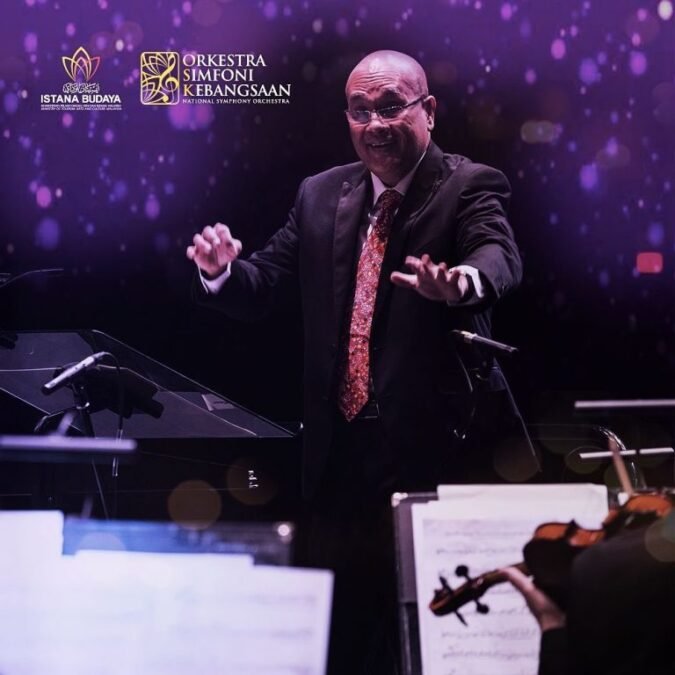
Initially known as the Young Symphony Orchestra and then rebranded with a new lease of life known as the National Symphony Orchestra or better known as OSK or National Symphony Orchestra (NSO) which was launched in 1993. Now OSK is under the auspices of the Ministry of Tourism, Arts and Culture and is managed by the Istana Budaya. The establishment of OSK is aimed at the main objective of promoting a comprehensive level of artistic appreciation among various layers of society, especially for lovers of classical music.
SK MUSICAL INSTRUMENTS
VIOLIN
VIOLA
CELLO
DOUBLE BASS
FLUTE
OBOE
CLARINET
BASSOON
FRENCH HORN
TRUMPET
TROMBONE
BASS TROMBONE
TUBA
OVERLOAD
PERCUSSION
RHYTHM SECTION
KEYBOARD
GUITARS
BASS GUITAR
DRUM
LATIN PERCUSSION
Sari Theatre
Sari theatre can accommodate 1408 people at a time, namely 788 people (including 124 seats on the orchestra stage, 26 seats in VVIP+VIP and 15 seats in Production) in the Front Sari (Stalls) located on the 1st floor, 328 people in the Main Sari (Grand Circle) on the 2nd floor, 16 people in the Gold Seats on the 2nd floor, and 292 people in the Upper Circle on the 3rd floor.
The Sari Stage can be rented by event organizing companies and commercial promoters with affordable service and facilities.
Sari Emblem
A smaller stage compared to the Sari Stage. It is located to the right of the Sari Stage. This stage is suitable for small productions with a capacity of 281 spectators at a time. The stage is in the shape of an arena with a floor area of 500 square meters.
Rental
Lambang Sari can be rented by event organizing companies and commercial promoters with affordable service and facilities.
| Description | Amount (RM) |
|---|---|
| Each Performance | 1,000 |
| Preparation and Training (Daily) | 500 |
| Deposit | 500 |
| Total Estimated Cost | 2,000 |
Visiting Information
HUBUNGI KAMI
ISTANA BUDAYA
Kementerian Pelancongan, Seni Dan Budaya Malaysia
Jalan Tun Razak,
50694 Kuala Lumpur
- +603 4026 5555
- +603 4026 5558
- +603 4025 5975
- info@istanabudaya.gov.my
- Opening Hours: 9:00 AM – 5:00 PM (office hours); show times vary
- Ticket Prices: Vary depending on the event (some performances are free for public cultural events)
- Guided Tours: Available upon request for school or group visits
Things to Do
- Attend musical theatre or cultural dance performances
- Explore the gallery exhibitions on Malaysian performing arts
- Join workshops and cultural festivals hosted throughout the year
- Enjoy architectural photography of the stunning palace exterior
Nearby Attractions
- National Art Gallery (Balai Seni Negara) – Adjacent to Istana Budaya
- Titiwangsa Lake Gardens – Scenic park for leisure and boating
- Petronas Twin Towers – Kuala Lumpur’s iconic skyline landmark
- Kuala Lumpur City Centre (KLCC) – Shopping and dining hub
How to Reach Istana Budaya
- By Train: Take the LRT Ampang Line to Titiwangsa Station; the theatre is about a 10-minute walk.
- By Bus: RapidKL buses frequently stop along Jalan Tun Razak.
- By Car: Easily accessible via Jalan Tun Razak with on-site parking available.
- By Grab/Taxi: Mention “Istana Budaya Kuala Lumpur” — a well-known landmark for drivers.
Frequently Asked Questions (FAQ)
1. What is Istana Budaya famous for?
It is Malaysia’s National Theatre, renowned for hosting major cultural and international performing arts events.
2. Is Istana Budaya open to the public?
Yes. Visitors can attend performances or request guided tours to learn about its architecture and history.
3. How can I buy tickets for performances?
Tickets can be purchased online via the Istana Budaya official website or at the on-site ticket counter.
4. Does the theatre offer shows in English?
Yes, both local Malay-language and international English productions are staged regularly.
5. Is photography allowed inside the theatre?
Photography is permitted in public areas but usually restricted during performances.






Comments are closed.